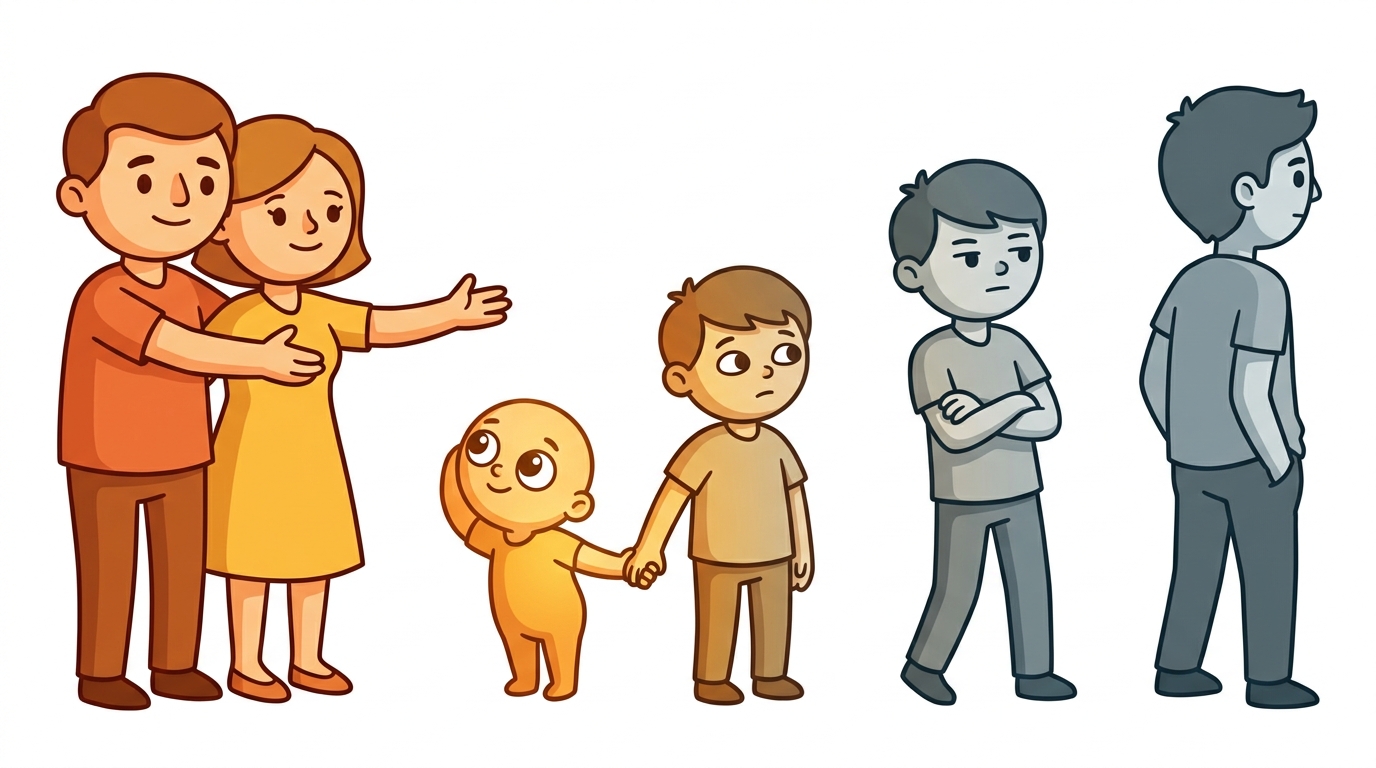
Let me ask you something — and I want you to sit with this question for a moment.
Have you ever looked at a child — maybe someone you know personally, maybe even your own — and thought:
“Their parents gave them everything. How did they still end up so lost?”
Good clothes. Good school. Every opportunity money could buy. Parents who stayed up late worrying, who sacrificed their own comfort, who poured everything they had into that child.
And yet… something still went wrong.
Today, we’re going to talk about why that happens. Not to blame parents — because most parents are trying. But because trying hard is not the same as trying right. And the difference between those two things? It changes everything.
Let’s go back. Not in a nostalgic, rose-colored way — but honestly. Back to the 1600s, the 1700s, even up through the early 1900s. How did parents raise children then?
Parents back then were direct. They corrected their children firmly — sometimes physically, yes — but always with a clear purpose. That child knew exactly what was expected of them. There were no grey areas. There were values, responsibilities, consequences. And the love was real — it just didn’t look like we think love should look today.
That parent who gave their child a firm correction wasn’t doing it because they didn’t love the child. They were doing it because they loved the child. They understood that love without discipline is just comfort — and comfort alone does not prepare a child for the world.
“The goal of parenting is not to raise a happy child — it is to raise a child who is capable of creating their own happiness as an adult.”
Now fast-forward to today. We live in an era where we’re terrified to say no to our children. We give a 12-year-old the power to choose their own school schedule. We ask a 9-year-old what they want for dinner every single night as if they’re running the household. We negotiate with toddlers. We explain ourselves to children who don’t yet have the emotional or cognitive tools to process those explanations.
And then we are shocked — genuinely shocked — when that same child grows up with no sense of direction, no respect for authority, no resilience when life gets hard.
A child is still a child, even when we stop treating them like one.
This isn’t just a feeling or a generational opinion. The research is very clear on this.
Studies published through the National Institutes of Health consistently show that children raised in permissive households — where parents offer warmth but very little structure or boundaries — grow up struggling with impulse control, emotional regulation, and self-discipline. They often have difficulty dealing with frustration, failure, or any situation where they don’t immediately get what they want.
Permissive parenting produces children who are impulsive and self-indulgent. They may be creative and socially engaging — but they lack the internal compass needed to navigate real-world challenges. Authoritative parenting — warm, loving, but structured and demanding — consistently produces the most well-adjusted children across cultures and economic backgrounds.
Notice that word — authoritative. Not authoritarian. Not harsh. Not cold. Authoritative means: I love you deeply, AND I will hold you to a standard. Both things are true at the same time.
The problem is that many modern parents have confused being a good parent with being a good friend to their child. And those are two completely different roles. Your child needs a parent far more than they need another friend.
Let me paint you a picture — one that many of us will recognize.
Imagine two families living on the same street. In the first house, the parents are strict but loving. The children have chores. They sit down for dinner together. The father talks about the time he almost lost his business — the sleepless nights, the hard decisions he made, what he learned. The mother shares stories about her own childhood mistakes and what those mistakes cost her. The children listen. Not because they’re forced to, but because they’ve been taught that the voices of experience carry wisdom.
In the second house, the parents are also loving — maybe even more outwardly affectionate. But there are no real rules. The children eat what they want, sleep when they want, spend hours on screens. If the child doesn’t want to go to school, the parent negotiates. The parents rarely share anything difficult about their own lives — they want to protect their children from that weight.
Twenty years later — which children are more equipped for life?
The research, and frankly, common sense, points in one direction every single time.
Here is something that parents in earlier generations did almost instinctively, that we have largely stopped doing — and the consequences are real.
They shared their own lives with their children.
Not curated, filtered, Instagram-worthy versions of their lives. Their actual lives. Their failures. Their embarrassments. The time they trusted the wrong person. The business that didn’t work. The relationship that broke them. The lesson they had to learn the hard way.
Dr. Robyn Fivush, a developmental psychologist who has spent decades studying family storytelling, found something extraordinary — adolescents who know more of their family’s real stories, especially stories of struggle and survival, show significantly higher self-esteem, lower rates of depression, and a stronger sense of personal identity.
When parents share their own life experiences — particularly stories of overcoming hardship — children develop a deeper sense of who they are and where they come from. This intergenerational narrative becomes an internal compass that guides children through their own challenges.
Think about what that means. When you tell your child about the time you made a terrible financial decision, you are not burdening them. You are equipping them. You are handing them a map of a territory they haven’t entered yet.
When you shield your child from every hard truth, every difficult story, every real consequence — you send them into the world completely unprepared. They have no reference point. No inherited wisdom. No emotional memory of how people survive hard times — because you never showed them.
Now we need to talk about something that might be the most uncomfortable truth in this entire conversation.
The biggest reason children go wrong despite good intentions is not just permissiveness. It’s not just a lack of storytelling. It’s this:
Most people become parents without ever seriously learning what parenting actually requires.
We go to school to learn mathematics. We train for years to get a job. We practice for months to pass a driving test. But to raise a human being — arguably the most important and complex responsibility any person can take on — we just… wing it. We default to how we were raised. Or worse, we react against how we were raised without any real framework to replace it with.
And because no one wants to admit they don’t know what they’re doing, we do something very human and very dangerous: we convince ourselves that our instincts are enough. That our love is enough. That our own ideas about childhood — gathered from our limited personal experience — are sufficient to guide another person’s entire development.
They are not. And the children pay the price.
Research consistently shows that parents who lack foundational knowledge of child development — and who don’t seek to learn — produce measurably poorer outcomes in their children. But when parents engage in even basic parenting education, the improvements in children’s behavior and emotional wellbeing are significant and lasting.
The saddest part? These parents often don’t realize the damage until it’s too late. Until their child is an adult who doesn’t call. Who feels no deep bond. Who can be in the same room as their parent and feel nothing. Not hatred — just emptiness.
That emptiness is the result of years of a relationship that was built on comfort but never on real connection, real guidance, or real preparation for life.
I want to be very clear before we close, because this matters.
None of what we’ve discussed today means that love is unimportant. Love is the foundation — it has to be there. A child who is not loved cannot thrive. Full stop.
But love is the foundation of a building, not the building itself. You cannot live in a foundation. You need walls. You need structure. You need a roof. In parenting, those walls are boundaries. That structure is discipline and guidance. That roof is wisdom passed down through honest storytelling.
If you are a parent listening to this right now — please hear this without guilt. Guilt is not what I want you to walk away with today. What I want you to walk away with is awareness. Because awareness is where change begins.
Ask yourself honestly:
Am I raising my child to be comfortable — or am I raising them to be capable?
Am I sharing my real life with them — or am I protecting them from it?
Am I learning what good parenting actually looks like — or am I assuming I already know?
The world your child is going to inherit is not going to be soft with them. It is not going to negotiate. It is not going to ask them how they feel before it delivers a hard lesson.
The kindest thing you can do — the most loving thing you can do — is prepare them for that world. Not by being harsh. Not by being cold. But by being intentional. By being honest. By being willing to learn what great parenting actually looks like and then doing the hard, quiet, daily work of living it out.
That is what the parents of the past understood. That is what we need to reclaim.
Your child doesn’t need a perfect parent. They need a present, intentional, and honest one.
And that — that is something every one of us is capable of becoming.
If this episode spoke to something in you — share it. With a parent you know. With a sibling who’s just starting their parenting journey. With yourself, if you need to hear it again.
And if you’re willing — drop a comment or send me a message. Tell me: what is one thing your parents did that you carry with you to this day? Good or hard — I want to hear it.
Until next time — take care of yourself, take care of your family, and remember: the work you do in the home is the most important work you will ever do.
