You know that moment.
It’s 8:47 at night. You’ve cooked dinner, cleaned it up, sorted the laundry, packed the lunches for tomorrow, and answered approximately forty-three emails you didn’t want to answer. Your body is running on whatever was left at the bottom of the coffee pot, and all you want — all you are asking for from the universe — is five minutes of silence.
You tuck them in. You kiss their forehead. You whisper goodnight and take one quiet step toward the door.
And then —
“Mom? Dad? Wait. I need to tell you something.”
And if you’re honest — if you’re really honest — your first thought isn’t warmth. It’s: here we go again.
Because you’ve been here before. You know exactly how this plays out. One thing becomes two things, two things becomes a story about something that happened at recess three weeks ago, and suddenly it’s 9:30 and nobody is asleep and you are sitting on the edge of a small bed wondering how you got here.
So you do what any reasonable, exhausted human would do. You say, “Okay, but just one more thing. Then it’s really time to sleep.”
And somewhere in the back of your mind, you’ve filed this away as a habit you probably need to break. Your kid stalls at bedtime. They push the limits. They can’t settle down.
That’s the belief. That’s what most of us carry into the night.
And I’m here tonight to tell you — gently, but completely — that belief is wrong.
Your child is not stalling.
They are not manipulating you. They are not running some elaborate scheme to steal twenty more minutes of consciousness. They are doing something far more instinctive, far more human, and honestly — far more beautiful than that.
They are reaching for you.
Here’s what’s actually happening in that small body at bedtime. The noise of the day — school, friendships, the hundred small pressures that even a seven-year-old carries — all of it starts to quiet down. The lights go low. The world gets still. And for the first time all day, there’s space. Real space. And in that space, everything they’ve been holding onto — the questions, the worries, the funny thing that happened at lunch, the feeling they didn’t have words for at 3pm — it all starts to rise to the surface.
A comprehensive review published in Sleep Medicine Reviews found that bedtime routines do far more than prepare children for sleep. They are one of the primary windows for parent-child attachment, emotional regulation, and language development. The physical closeness, the lowered voices, the unhurried pace — all of it signals safety to a child’s nervous system. And when a child feels safe, they open up.
Child psychologist Dr. Laura Markham puts it plainly: bedtime is when a child’s emotional guard comes down. The defenses they’ve maintained all day — the performance of being okay, of being brave, of holding it together — they don’t need those anymore. It’s just you and them and the dark. And in that moment, the real stuff comes out.
That chattiness? That stream of random questions and wild stories and “one more thing”?
That’s not avoidance. That’s trust.
So let’s rebuild how we see this moment. Because once you see it differently, it changes everything.
Think about the last time you were going through something hard. Maybe you were stressed about money, or worried about a relationship, or carrying something heavy you hadn’t said out loud yet. And think about when you finally talked about it. Was it at 2pm in a busy room with the TV on? Or was it late at night, in the quiet, when the world had slowed down enough for you to finally find the words?
Children are no different. They just haven’t learned yet to schedule their vulnerability.
And here’s the part that should stop us in our tracks — research on parental emotional availability shows us what happens when we consistently don’t show up for those moments. When we shush, redirect, or rush through bedtime connection night after night, children don’t simply learn to fall asleep faster. They learn something far more lasting: that their inner world is not welcome here.
A study exploring how parental dismissal shapes emotional development found that children whose feelings are regularly minimized grow into adults who struggle to express themselves, to trust others, and to ask for help. What feels like a small nightly choice — not tonight, I’m too tired — compounds, quietly, over years.
And the numbers are already telling that story. Research tracking over 14,000 children in the United States found that nearly 40% lack a secure emotional bond with their parents. Perhaps even more sobering — one in four of those children actively avoid going to their parents when they’re upset, because experience has taught them their needs won’t be met.
One in four.
These are not bad parents. These are tired parents. Parents who didn’t realize that those ten minutes at the end of the day were quietly building — or quietly eroding — something irreplaceable.
There’s a moment that gets shared in parenting circles — you may have seen a version of it online, or maybe you’ve lived it yourself.
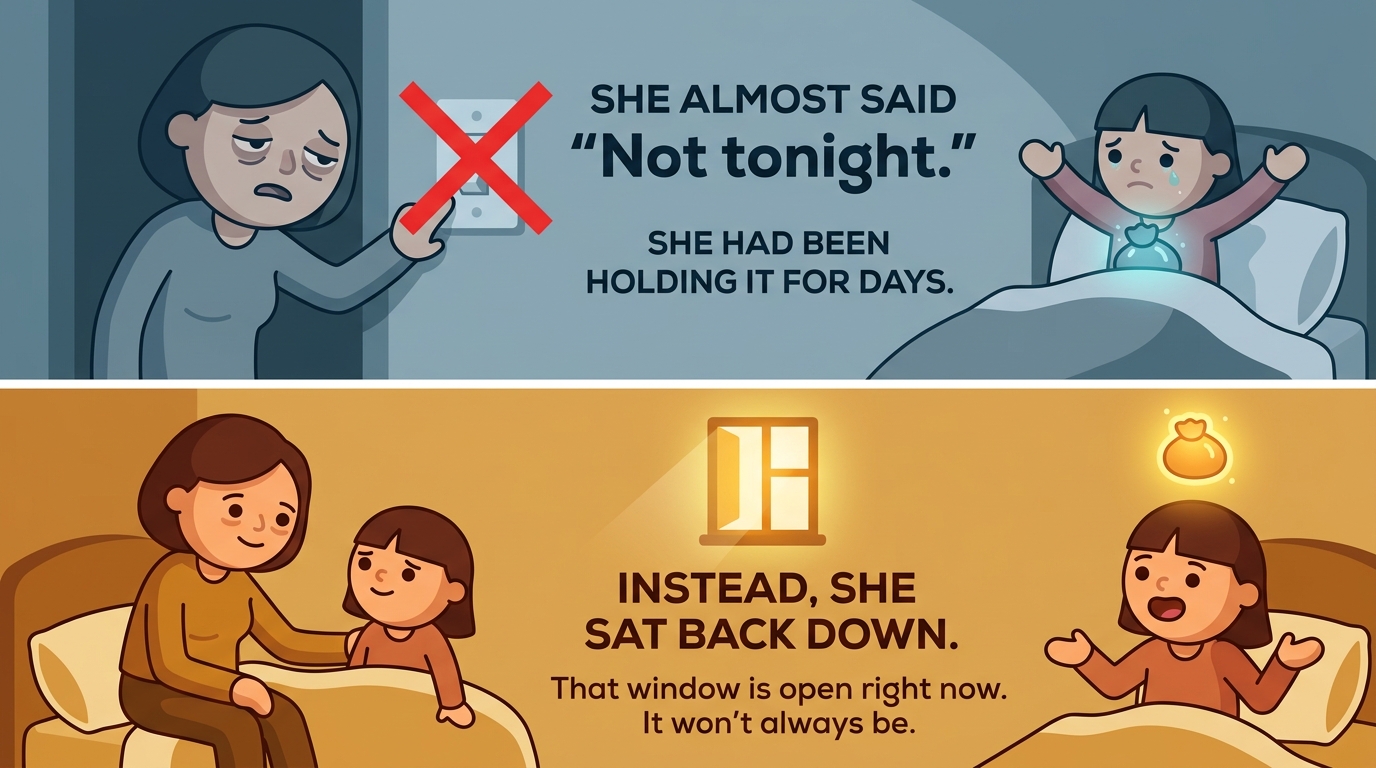
A mother describes the night her eight-year-old daughter wouldn’t stop talking at bedtime. She was exhausted. She’d had a brutal week at work. She almost said, “Not tonight, sweetheart. Go to sleep.”
Instead, she sat back down.
And in those next twelve minutes, her daughter told her — haltingly, quietly, in the way that children do when they’re not sure if the words will be received — that a girl at school had been saying unkind things to her for weeks. That she’d been crying in the bathroom so no one would see. That she hadn’t told anyone because she didn’t want to be a problem.
She hadn’t been stalling. She had been working up the courage for days.
That mother said later: “If I had turned off the light, I wouldn’t have known. And she would have learned that her pain wasn’t worth my time.”
That’s the weight of the bedtime window.
Not every night will carry that kind of moment. Most nights it really will be a story about something funny the dog did, or a question about whether fish sleep, or a request for one more glass of water. And those nights matter too — because those small, low-stakes conversations are the training ground. They are how your child learns that you are safe to talk to. So that when the big night comes — and it will come — they already know the door is open.
I’m not asking you to be a perfect parent at 9pm when you’re running on empty. I’m not telling you every bedtime needs to be a profound emotional experience. That’s not real, and it’s not sustainable.
What I’m asking is smaller than that.
The next time your child says “Mom, wait — I need to tell you one more thing” — before you reach for the door handle, take one breath. Just one. And then turn back around.
You don’t need a plan. You don’t need the right words. You just need to sit down, look at them, and say: “Okay. Tell me.”
Put your phone face down. Let the silence that follows be comfortable. Ask a follow-up question, even a small one. Let them wander through whatever they need to wander through tonight. Because to your child, your undivided attention at the end of the day is not a small thing. It is love in its most tangible form.
They are not going to remember the perfectly packed lunchbox. They won’t remember the new shoes or the birthday cake or the grade on the spelling test. But they will remember — in the deepest, quietest part of who they are — that in the dark, when the day was over, your voice was there. Soft and unhurried. Listening.
That memory is the foundation they’ll build everything else on.
So let’s retire the story that bedtime chatter is a problem to be managed.
Let’s replace it with the truth: your child is not stalling. They are choosing you. At the end of every day, out of every option available to their small and busy mind, they are turning toward you and saying — in the only way they know how — I trust you with the real stuff.
That window is open right now.
It won’t always be. But tonight, it’s wide open — and all it costs you is ten minutes and the willingness to listen.
If this resonated with you, share it with another parent who needs to hear it tonight. And the next time bedtime stretches a little longer than you planned — smile. You’re doing something right.
Take good care of yourself, and those little ones.
See you in the next one.
