You’re standing in the middle of Shinjuku Station in Tokyo — the busiest train station on the planet. Every day, over three million people pass through. It’s rush hour. And yes, it is loud… but not in the way you’d expect.
Because if you look down… right there, beside a pillar near the ticket gates… there’s a five-year-old boy. Sitting. Still. No iPad. No snacks being negotiated. No whispered threats from a frazzled parent. Just a little boy, watching the trains go by, utterly at peace with the world.
Now I want you to hold that image in your mind, because I’m about to tell you something that will reframe everything you think you know about raising children.
Here in the United States, surveys consistently find that the majority of parents report feeling overwhelmed by daily tantrums and power struggles. We yell. We bribe. We count to three. And then we collapse onto the couch at 8pm wondering what we’re doing wrong.
But in Japan? Something is measurably different. And it’s not strictness. It’s not fear. In fact, it’s the exact opposite.
What we’re going to explore today is a layered cultural philosophy, backed by emerging neuroscience, that most Western parents have simply never encountered. And by the end of this video, you won’t just understand why Japanese children are calmer — you’ll have a clear, practical roadmap for creating that same calm in your own home.
Let’s start with the story of why we got here.
Most of us were raised inside an invisible belief system about children. It goes something like this: children are impulsive, selfish creatures, and our job as parents is to civilize them — fast. We use reward charts. We use timeouts. We raise our voices when nothing else works.
This is called behavioral conditioning. Reward the good, punish the bad, shape the outcome.
And the yelling cycle is the clearest expression of it. Let me paint a picture you might recognize.
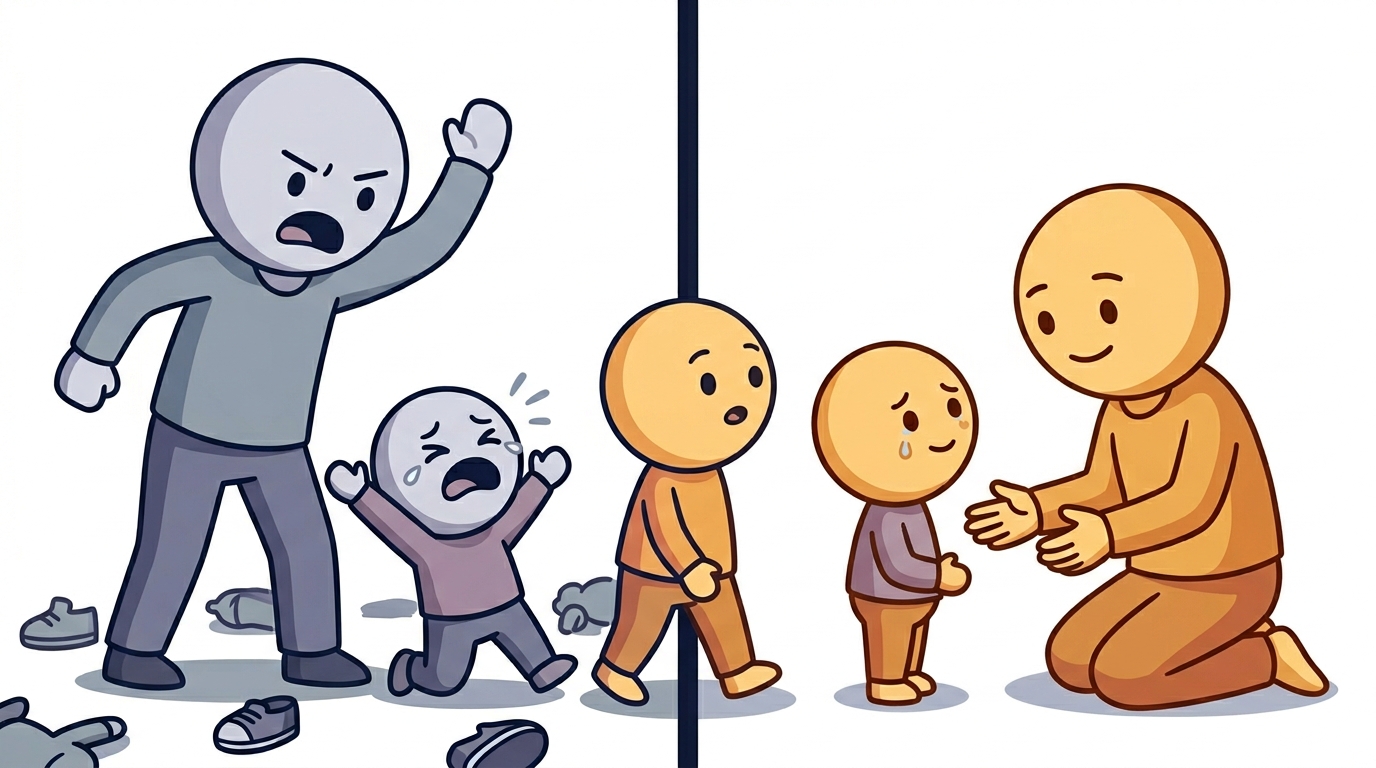
It’s a Tuesday evening in Chicago. Marcus, age six, has been asked three times to put his shoes away. Three times, he’s ignored it. On the fourth ask, Dad’s voice goes up. On the fifth, it cracks into a shout. And finally — finally — Marcus moves.
It worked. So Dad does it again the next day. And the day after that. And slowly, without anyone choosing it, yelling becomes the only currency that buys cooperation in that house.
But here is what’s happening in Marcus’s brain that his dad can’t see.
Research note: A 2025 neuroimaging study published in PMC found that children exposed to persistent harsh parenting — not abuse, just chronic yelling and pressure — showed measurably reduced gray matter volume in both the prefrontal cortex and the amygdala.
Every time a parent yells, the child’s amygdala — the brain’s alarm system — triggers a flood of cortisol, the stress hormone. And what cortisol does, brilliantly but brutally, is shut down the prefrontal cortex. The part of the brain responsible for logic, cooperation, empathy, and impulse control.
In other words, by yelling to force obedience, we are biologically preventing our children from being able to comply.
We are not raising kids who don’t listen. We are growing the conditions that make listening impossible.
This isn’t a character flaw. It isn’t a parenting failure. It’s what happens when we’re working with an incomplete map. And that’s what today is about — giving you the rest of the map.
Japanese parenting philosophy isn’t a trending TikTok method. It’s a centuries-old cultural orientation toward children — one that modern neuroscience is now catching up to and validating in real time. Let’s walk through it together.
RULE 1 — Shitsuke: Beautiful Training
In the West, we translate “discipline” as control — something you do to a child. In Japan, shitsuke means something closer to beautiful training — a way of life you demonstrate, not enforce. Discipline isn’t a reaction to bad behavior. It’s a daily posture of modeling the world you want your child to inhabit.
RULE 2 — Skinship: The Science of Closeness
This one surprises Western parents most. In Japan, mothers practice something called skinship — sustained physical closeness. Co-sleeping is common well into the early school years. Babies are carried, held, kept near.
In the United States, we are often told to give children their own space early — their own room, their own crib — as a way of building independence. But cross-cultural research tells a different story.
Research note: BYU Scholars Archive research found Japanese mothers consistently prioritized emotional attunement and physical proximity over early behavioral independence — a pattern directly linked to more cooperative children in later years.
Children whose earliest experiences are ones of physical safety and proximity develop what psychologists call secure attachment. And children with secure attachment are, counterintuitively, more cooperative, more emotionally regulated, and more independent later on — not less. The connection came first. The calm followed.
RULE 3 — Maywaku: The Empathy Instruction
Here’s a moment that changed how I see everything. In Japan, when a child is misbehaving, a parent rarely says “stop that because I said so.” Instead, they might say: “If you run through the hall, the person downstairs will be bothered.” Or: “If you leave your shoes here, someone might trip.”
They teach children to understand the ripple effect of their actions — how their behavior touches the group, the family, the world around them. Empathy becomes the engine of behavior, not authority.
And this matters deeply. Children who understand why something matters will generalize that lesson. Children who obey because they’re afraid will only behave when someone’s watching.
RULE 4 — Gaman: Building the Patience Muscle
This is perhaps the most misunderstood principle. Gaman translates roughly as patience or endurance — but it’s not suffering. It’s the trained capacity to sit with discomfort without collapsing.
Research note: Yanaoka et al. (2022), published in Psychological Science, compared Japanese and American children on a cross-cultural delay of gratification study. Japanese children waited nearly three times longer for food rewards. The researchers concluded this wasn’t genetic — it was habit, shaped by cultural practice from an early age.
Here’s what gaman looks like in a practical moment. Imagine you’re at the grocery store. Your daughter, Amara, spots a toy on the shelf and starts to cry. The old script is to either give in or get angry — both of which teach the child that emotional flooding gets results.
The gaman approach: you kneel down. You say, “I see that toy looks really fun. It’s hard to leave it here, isn’t it?” She nods. You say, “We’re going to practice our gaman together. Can you take a breath with me?” And you wait. Not distracted, not bribed — just present, modeling calm.
This is what neuroscientists call building prefrontal muscle. The ability to delay gratification is one of the strongest predictors of adult resilience and success that we have in the psychological literature. And it is taught. In small moments. At grocery store checkouts.
RULE 5 — Shokuiku: Food as a Lesson in Belonging
In Japan, lunchtime at school isn’t a break from learning — it is learning. Children serve each other. They clean up together. They express gratitude for the meal. It’s a daily ritual of contribution, not consumption.
A real-world example: John, a father in Houston, began involving his six-year-old son in meal preparation and cleanup at home — not as a chore, but as a shared family ritual. Within weeks, he noticed a marked decrease in his son’s entitled tantrums. The reason is profound in its simplicity: his son no longer felt like a passenger in the family. He felt like a crew member.
Children who feel capable stop needing to act out for power — because they already have it.
RULE 6 — The Independence Ladder: Small Risks, Big Confidence
In Tokyo, it’s normal to see a seven-year-old riding the subway alone to run a family errand. In most American cities, this would cause alarm. But this practice — giving children manageable real-world responsibility — builds something called self-efficacy: the internal belief that “I am capable.”
Start small. Let your child walk to the neighbor’s house alone. Let them order their own meal at a restaurant. Let them fail a small thing without you rescuing it immediately. Every small independence deposits confidence into an account that pays dividends for a lifetime.
RULE 7 — Low-Conflict Communication: The Mirror Method
Japanese parents use “no” sparingly, and almost never as a blunt instrument. Instead, when a child is escalating, they reflect the emotion back before redirecting the behavior.
“You seem really frustrated that we have to leave the park.”
Full stop. No “but.” No “however.” No “you need to calm down.” Just the reflection.
What happens in a child’s nervous system when they feel genuinely seen — not managed, not lectured, but seen — is remarkable. The cortisol drops. The prefrontal cortex comes back online. And suddenly, cooperation is biologically possible again.
RULE 8 — The Textbook Back: Lead by Example
There is a Japanese proverb: the back of the parent is the child’s textbook. Everything you want your child to become, you must first embody. You want a child who doesn’t yell? You must stop yelling — especially when it’s hardest, when they’re at their worst. You want a child who is patient? They need to watch you practice patience when you’re running late and the traffic is impossible and dinner is burning.
This isn’t about being perfect. It’s about letting your child witness you returning to calm after losing it. That recovery? That’s the real lesson.
Understanding these principles is one thing. Living them inside a busy household on a Tuesday is another. So here’s how we translate this into a real, doable sequence.
C — Connection Before Correction
Before you give any instruction, make physical contact. A hand on the shoulder. Eye level. A whisper instead of a shout. You are not just being gentler — you are activating your child’s social engagement nervous system, which is the only state in which learning and cooperation can actually occur.
A — Attachment Investment
Fifteen minutes of uninterrupted floor time every single day. No phone. No agenda. Just you, following their lead. Children who receive this kind of attuned parental presence are more cooperative, more emotionally resilient, and more trusting of boundaries — because the relationship account has been filled.
L — Logical Limits
Every rule in your house should come with a “because” that a child can understand. Not “because I said so” — but “because when we leave shoes in the doorway, someone might fall and get hurt, and we take care of each other in this family.” The why converts a command into a value. Values are internalized. Commands are resisted.
M — Modeling the Standard
You are always teaching, whether you intend to or not. The question is only what lesson you’re delivering. When you speak quietly under pressure, you teach quiet strength. When you repair after a rupture — when you go back to your child and say “I raised my voice and I’m sorry, that wasn’t fair” — you teach repair. And repair, in the end, is the skill that sustains all relationships.
Here’s the shift that underlies all of this — and it might be the most important thing I say today.
The goal was never obedience.
The goal is relationship. And from a deep, safe, genuinely connected relationship, cooperation flows naturally — not because children are afraid of consequences, but because they are bonded to the person asking.
Japanese parenting, at its heart, is not a set of techniques. It’s an identity: I am not the boss of this child. I am their guide. And my greatest tool is not my authority — it’s my example.
When you combine these ancient cultural principles with what modern neuroscience now confirms about the developing brain, the results aren’t just calmer children. They are children who feel genuinely seen. Families where connection — not fear — is the operating system.
That’s what we’re building here.
YOUR FIRST STEP — RIGHT NOW…
When this video ends, I want you to do one thing.
Go find your child — wherever they are in the house. Don’t say anything about their chores. Don’t mention homework. Just find them, get to their level, and hold them for ten seconds. That’s it. That’s the whole assignment.
Tomorrow, try the proximity rule. No calling from other rooms. Just walk to them, every time.
Do that for seven days. Come back here and tell me what you noticed.
And if you’re ready to stop the yelling cycle for good, drop the in the comments right now. And share this video with others that might truly need it. By the way I read the most interesting comment in our next video,
You won’t want to miss it
